Advanced Materials
The material performance is quite often the rate-limiting factor for the innovation of new technologies and products. Advanced materials with high performance and unique properties enable the development of new technologies and products, increasing the quality of our life in general. For example, the current internet and information age is made possible with the development of new materials such as optical fibers and semiconductor materials. As such, new enabling materials are continuously sought to achieve breakthroughs in energy, national security, and other technologies and products.
The focus of advanced materials at ASL is to design and develop new materials, particularly structural materials combined with novel functional properties. The research activities are driven by client specific applications covering development, processing, and characterization of novel alloys and composites. A particular research theme at ASL is to formulate new material chemistries and process them into novel microstructures. The decoupling of materials chemistries and their microstructures is a powerful tool to design new materials, which can combine ultra-high strength structural properties with other functional properties. This approach allows achieving unique material properties beyond the envelope of current materials.
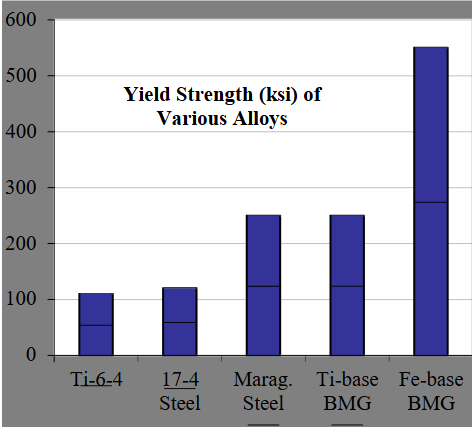
Bulk Metallic Glasses (Bulk Amorphous Alloys) are a good example of this approach. These are a new class of metallic alloys with a novel amorphous atomic structure combined with a unique set of alloy formulations. The amorphous atomic structure provides very high yield strength in as-cast form, also a cost-effective net-shape manufacturing process for various high performance products. The alloy formulation can be tuned and optimized to achieve various functional properties such as corrosion resistance, biocompatibility, and magnetic properties.
The atomic structure is the foremost striking characteristic of the BMG’ as it fundamentally differentiates from ordinary metals. The figure below shows a TEM micrograph, where the atomic structure of BMG versus the atomic structure of a conventional metal (Zirconium) is shown. The atomic structure of conventional metals is a periodic structure in which the layout of atomic species shows repeating patterns over an extended range. This atomic structure is called “crystalline” and is said to have long-range order. By contrast, no discernable patterns exist in the atomic structure of BMG’s, which is called amorphous and said to have no long-range order. For the first time, amorphous atomic structure became possible for the solid bulk forms of metals with the discovery of BMG’s. This unique atomic structure places BMG’s in a new domain of properties unattainable by ordinary metals.
Another unique property of BMG’s is the superior elastic strain limit: i.e., the ability to retain its original shape (memory) after undergoing very high loads and stress. For example, a typical Ti-base BMG has an elastic strain limit of 2% exceeding any other metallic alloy. Under shock conditions, the elastic strain limit can reach up to 4%. These and other properties show some variation with chemical composition of a specific BMG alloy. As such, optimization of some properties can be achieved to a certain degree by varying chemical composition.